
A problem with autistic memoir
An insight into the thought process of a thesis chapter

For my PhD thesis on (what I term) the diagnosis memoir, I am writing a chapter on autistic memoir. I am defining this not by early autistic autobiography like Temple Grandin’s various books, but the more recent phenomenon of books by (so-called) late-diagnosed women who are often already writers in some capacity, either journalists or authors. Late-diagnosed women are often labelled high-functioning: they can live mostly ‘normal’ lives. A lot of the time this diagnosis is precipitated by intense burn out, a side effect of living years and years as if they were neurotypical.
Alongside this, and on a slightly different tangent to my thesis, there are the rainbow-coloured self-helpy books more heavily pushed by Waterstones and other big retailers, the emergence of autistic influencers on platforms like Instagram and TikTok, and then, of course, the inevitable pushback suggesting that autism (and ADHD) is now over-diagnosed (because it is certainly more visible). None of this existed when I was 16 and a psychologist first raised the possibility that it might be worth screening me for autism. There is obviously way more awareness now on how being autistic can impact people’s lives (especially, and with a LOT of over-emphasis on, white middle-class women), and there is the general vague notion of ‘acceptance’ and ‘representation’ that some of these books and some of these influencers cater to. I think I know why incredibly bright colours are now associated with neurodivergence (dopamine? Standing out? Embracing the seemingly childlike aspects of neurodivergence? Embracing difference equals happy?) but it doesn’t make it less grating.
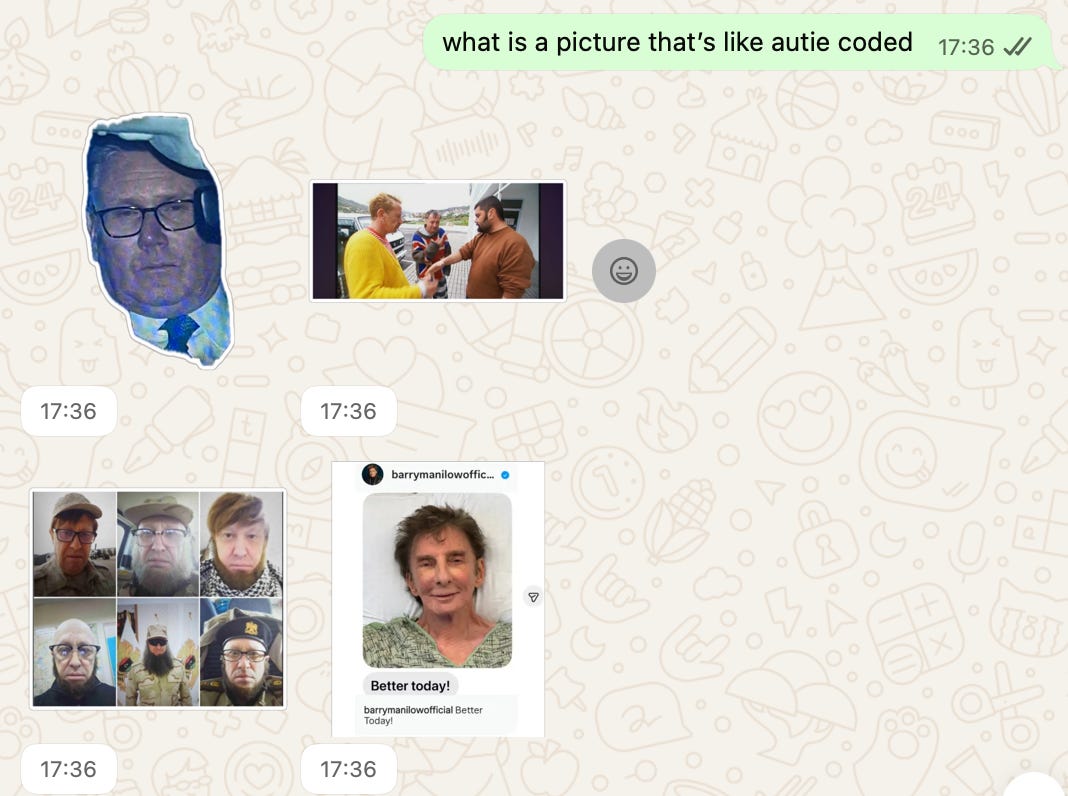
There’s also possibly a whole thesis to be written about internet culture, short-form vids and autistic representation. Though I did just cast aspersion on (SOME!) autistic influencers, I often find that what I find most relatable are my favourite autistics online who can perhaps more easily summarise the frustrations common to an autie’s walk through life that are harder to represent in book form. It’s interesting how this in itself is a form of communication, a way of telling ‘this is what it’s like’. I send them to Joe a lot as sometimes a video or meme can explain more than I can through my own verbal testimony, and I send them to Hannah all the time as more of a ‘look, it’s us’1. Often these vids/memes articulate something I wasn’t fully aware of. As I will discuss, this type of identification is perhaps problematic (and NOT in the ‘autism is overdiagnosed’ way or ‘everyone is a little bit autistic’ way). At the same time, this type of content can open tunnels of understanding through mutual recognition of autistic experience.
In my thesis so far, I’ve written about breast cancer memoir through Anne Boyer’s singular The Undying, and the more normative modes of narrating breast cancer as a brave journey of triumph over disease. I’ve also written about more contested diagnoses like CFS/ME, which I was diagnosed with when I was 13, using Alice Hattrick’s amazing Ill Feelings. I love these memoirs, and I’ve loved writing about them. Alas, for what might be the most personal chapter, it’s been a pattern of research frustration. There are a few reasons I can decipher why this might be. The most glaring one I think I have identified, is that a lot of the time these memoirs are forced to take on an explanation-based form. I described it to Hannah as an information manual, that these memoirs are often rehashing a similar script about what autism is and how it affects people. This can feel like these memoirs are written for either a neurotypical reader, or for someone who knows absolutely nothing about autism. Sometimes it feels like they are written to pacify the medical professional, or even to pacify the neurotypical. This is true for other forms of disability too. This way of narrativising diagnosis often goes like this: Here are a list of symptoms and signs. I will list them all, so you know it has a significant impact. Then you will believe that this diagnosis is real, that my suffering is sufficient. This is not to say that traits, symptoms and signs are not important—of course they are. But I wonder whether the focus on them is detrimental.
What can also happen in these memoirs is that sections or chapters are unself-consciously organised by these traits. Stimming, for example, or experiencing social interactions differently, or intense interests. This can be an effort to dispel pre-conceived notions about said traits (like ‘neurotypical people stim too’), but again this returns us to this explanatory quality. I think my problem with this is that it perpetuates an idea that of autism as a condition that is purely defined by a list of boxes to be ticked. Back in the days of 2022 when I got my first office job and realised I might want to pursue a diagnosis (mainly so I had a bit more protection in those kinds of environments) I had to fill in an AQ-10 questionnaire. It was obviously completely impossible to reduce my experience of life to a series of tick boxes. I like to collect information about categories of things (e.g. types of car, types of bird, types of train, types of plant etc) Definitely Agree / Slightly Agree / Slightly Disagree / Definitely Disagree. And yet, this is the first step to any medical recognition of being autistic.
I understand the desire to want to be understood by the medical establishment. And this, in turn, returns us to the structuring theme of these memoirs: that it has always been harder to diagnose autism in women because of the historic interpretation of autistic traits. In the above example—types of car, types of bird, types of train—only perceived masculine interests are listed, and in the ‘language’ of neurotypicals. It is, in some ways, a valiant task – to dispel these myths for each trait one by one, and the motivation behind it is clear. It is a way of narrating a story of autism outside of the often very damaging stories written by past researchers. Those stories are still perpetuated today—it’s not easy to get a diagnosis. My GP referred me to a diagnostic service that rejected my application because of ‘lack of co-morbidity’. I was initially devastated: they hadn’t asked for the information I could have easily supplied about my history of other diagnostic conditions. They didn’t know me! And this was despite having in their possession the AQ-10 questionnaire that quite obviously indicated that I displayed autistic traits, even though the questions themselves are skewed. A lot of what I wanted in that moment was medical validity, even as I was refused it.
Which is to say, I understand the compulsion to explain. I understand the need to communicate in whatever ways are viable. I understand the overwhelming need for validation, the freedom of a plausible explanation for every symptom cluster and disordered pattern of behaviour. For every fucking breakdown over a supposedly small thing, there was actually a reason. It is sooooo satisfying to have one thing encompass this and this and this. I did eventually get some of the high of a diagnosis, but then I also got the comedown too.
One of the problems with some diagnosis memoirs is that diagnosis is the formal climax, the lens through which everything else is understood, as if diagnosis is innate, with rigid borders, and not a human structure with flaws. One memoir I am studying for this chapter has a loose focus on certain traits like intense interests, or use of language, and reflects on how the author observes these traits in herself—but, I suspect as the author is also a journalist, it also includes short snippets of interviews with other autistic women. She also briefly mentions historical figures like Beatrix Potter, not to deeply interrogate the ways in which we could retrospectively diagnose Potter as autistic, but to illustrate that different ways of being have always existed, even before the large-scale recognition of autism as a neurological diagnosis. I think the borderline obsession with understanding and explaining the list of traits takes us away from the relational (that we understand ourselves through understanding other people), and the fact that autism can only really be understood as something that is also the product of society. The multiplicity of autistic perspectives is so important to ever having an accurate picture of what being autistic is like.
When I think of my friends who are either diagnosed autistic, or suspect that they are, or even if I encounter the art of an autistic person, I don’t expect a listing of how they fulfil the criteria of being autistic, so why is that seemingly the expectation for autistic memoir? When I try to understand the autistic mode of being, it goes so far beyond the confines of the quizzes we always have to take. I believe there are ways of telling autistic stories without resorting to a manual re-telling of what autistic people are often reduced to while still remaining autistic; I also want neurotypical people to try and understand autistic people outside these traits. And for autistic people to understand themselves outside these traits. The wider outside the confinement of autistic traits the better.
I often marvel at mine and Hannah’s many modes of communication. There are ways in which we communicate that are beyond explanation. I think any autistic person with a close autistic friend will get this. It reminds me of the so-called double empathy problem, that communication or connection between the neurotypical and the autistic is strained because neither can understand the other’s ways of thinking/behaving/being. It’s NOT that the autistic person cannot empathise with the neurotypical person, because the neurotypical person can equally not ever fully understand the way an autistic person processes the world. It puts the onus on both to make attempts to understand the other, rather than the current reigning belief that the autistic person should bend themselves to fit into a neurotypical world. All this to say, the ways that autistic people communicate has so much depth and breadth and is somewhere where it’s actually easy to see ABUNDANCE rather than LACK, if you frame it the right way.
So cool that you are writing about this. Loved what you said in the footnote about autie communication being an area of abundance rather than lack - don't think I've read that anywhere else! Have you come across Letters to My Weird Sisters by Joanne Limburg? I think you would like it