
Cats and God
Does any of this make sense?

Last week I naively started writing a post on the Substack app, thinking I could save it as a draft, about giving up Instagram for Lent and what I’d seen in the meantime and how I relate to it differently when I’m not instantly sharing what I see. Maybe that piece will still come but the Substack app froze and all those words disappeared.
In the meantime I’ve been on a train that caused an acute back spasm that I’ve been nursing while reading This Is the Door by Darcey Steinke.
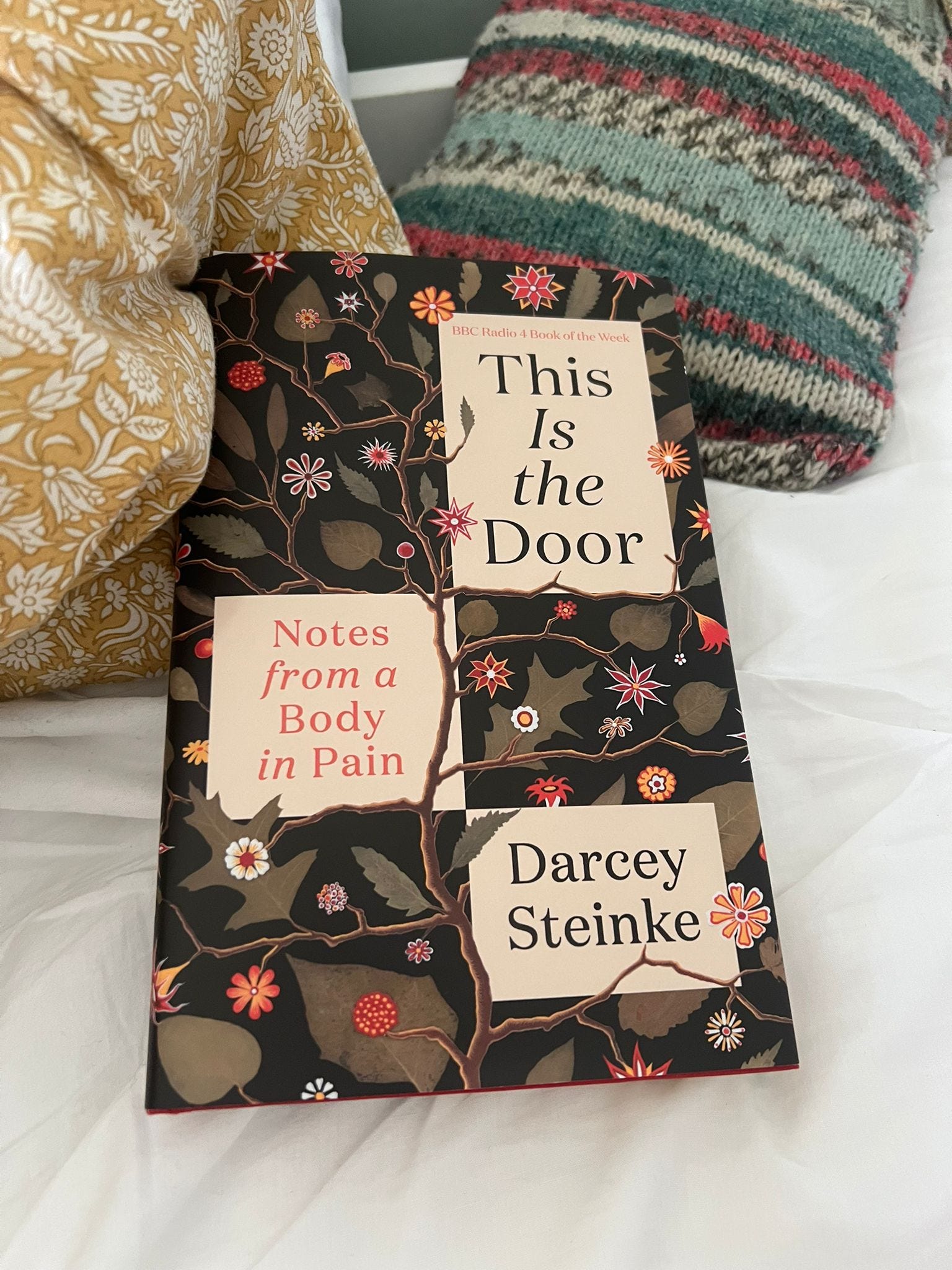
This book has the superb ability of raising my hackles one page and softening me on the next. And though I can imagine some people might find this annoying, it isn’t criticism because it’s invigorated thought in me. The constant push and pull between “God isn’t real and suffering is meaningless” and “God is real and our suffering means something” evokes a response in me that feels similar to how I experience faith (or lack thereof). While reading I wrote in my phone notes (among other things about God): It is when the idea of God is challenged that I can find my belief. It is when the idea of God is taken for granted, that I discard it.
I don’t know whether this is a personality trait of mine, a contrariness that I either am at the mercy of or something I nurture. But when someone says something is not true and I believe it to be true, I become animated, my blood pulsing quicker. When someone says something is true that I believe to be true but in a different way, I cannot engage as forcefully if at all. I’ll leave that, I think (I think).
My Dad’s Mum, Gran, died when my Mum was pregnant with me. Gran told Dad I’d be a strong-minded girl. This was when gender reveals happened at birth (I don’t know how common it was for other people in the 90s but my parents didn’t know either mine or my brother’s assigned gender until we’d exited Mum’s body). When I was a teenage feminist I used to love to invoke my Gran’s physic prediction, well aware that my strong-mindedness tipped over into stubbornness. That stubbornness can be born from my rigid thinking. That rigid thinking traps me. That nuance is a muscle I quite often have to remember to engage.
When, for example, the Hamnet pile-on was unfolding, when there was boasting of not crying, or instead that the crying that took place was only due to manipulation, I became incredulous, unable to understand a particular reading of a film I cried at and yes, had expected to cry at. Then I saw a video of Buckley and Mescal both admitting a hatred for cats and decided I didn’t actually like the film that much at all, and would never defend it again. Why such a strong reaction to a dislike of cats? Because of what it reveals about one’s character.
But Naomi, my internal voice says, they are only actors. When you watch a film it is not them you are watching, or shouldn’t be anyway. But I went to such lengths to—at least internally—defend their work as actors outside the bounds of what other people were describing as “grief porn”. What were supposedly thin and gossamer depictions of grief involving screaming, and reciting to be or not to be, I eked out to be more complicated (using, I suspect, the impressions I had from my reading the book, and my imagination). And yet, how can an actor be an actor and not even try and understand the subtle and idiosyncratic emotions of cats? And why, as I still don’t understand, do I feel so strongly about it?
Why do I feel so strongly about anything? This is not something my cat asks herself, even though she is my strong-minded companion. I’m glad for these reactions, as sometimes I feel so wispy nowadays that I might just be blown away. Mitski’s new album (thank God) has two cat songs and cats on the cover.
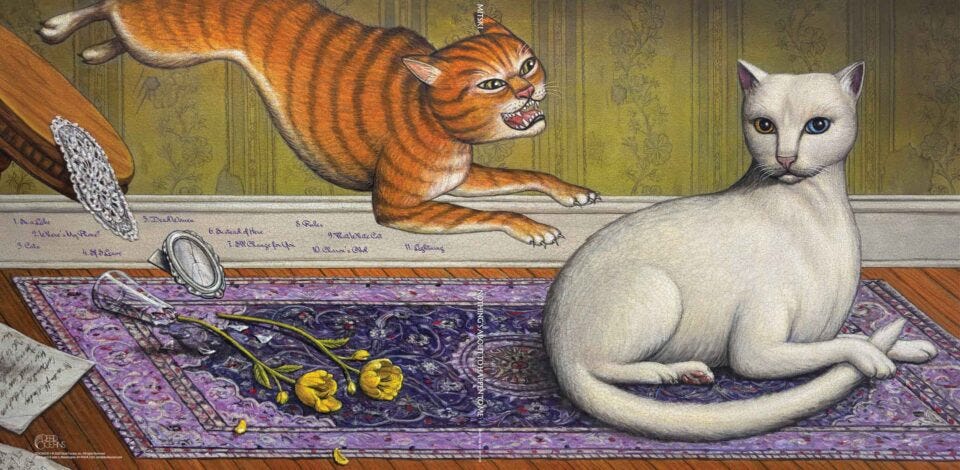
In one interview she is asked whose consciousness she would experience if she could, and she answers that it would be her cats. How mysterious they are in their proclivities, and how illuminating it would be to grasp them. In another, she says that cats are misunderstood, especially by patriarchy. Cats don’t respond exactly how a human might want them to, they don’t follow commands. Much like the strong-minded girl my Gran imagined. I don’t often believe in gendering things nowadays, but there is the irresistible feminine/masculine opposition between cats and dogs. There are plenty of feminine dogs. But if you don’t like cats, (I think, allowing myself to engage my no-nuance thinking) then you don’t like when a woman doesn’t do exactly what you want her to do.
Our cat Freddie would often hang around the churchyard, weaving between graves. She could be seen accompanying strangers who were tending to their relative’s tombstones. She once followed me through the alley around the back of our house, even though I didn’t ask her to. She’d follow Dad to church and back. She didn’t often go inside but did once when we were on holiday for 10 days, as if she was looking for us there. One evening the church was being used for a ticketed event and dad was on duty as a, shall we say, bouncer when a, shall we say, rabble rouser familiar to Dad wanted to be let in. Freddie was there and he pointed to her and said to Dad “that cat knows more about God than you!” and Dad replied, “of course she does, she’s my cat!”. I like this story because it was especially true of Freddie that she knew more about God than anyone.
It’s also true of cats that you might make them the comfiest bed and they’ll sleep on a flattened cardboard box. You might buy them a new toy and they’ll play with the years-old feather that is for some reason damp and becoming as threadbare as a feather can. You’ll get a water fountain and they’ll drink the rainwater from a watering can. You let a cat into a room and then they want to be let out. A certain wilfulness pervades their life, a contrariness perhaps. They will decide what is comfy, even if certain ideas of comfiness are provided. Perhaps they find what they want by rejecting something else. Maybe it isn’t contrariness, maybe it’s considered choice that is perceived as being difficult - and that’s why people who want an easy time reject the idea of a cat.
My recent understanding - It is when the idea of God is challenged that I can find my belief. It is when the idea of God is taken for granted, that I discard it - feels like a cat one. Is it stubborn for no reason? Or a way to retain a consideration? My resistance to observing belief in church seems to stem from the ways in which doubt or development of not-doubt, has no space within the confines that (as I am reminded of) have to be there in order for organised religion to be organised. And yet, I remain like Freddie, weaving through the churchyard, knowing about God if I don’t think too hard. Maybe it’s not contrary, to not know what side of the door you want to be on. Or rather, to want the door to be always open.
So much of what you're saying - simultaneously black-and-white/nuance-free but deeply insecure thought; a deep love of/identification with cats - I relate to; you see it as gendered, but I relate it to autism; 'all cats are autistic' is the phrase that I've heard from others. I don't know if you're comfortable with me medicalizing it, even though you have been diagnosed - I have a very similarly polarized/contradictory relationship with my autism as well. But I figured it was worth mentioning